By Raymond Nash
Section 70106 of H.R. 1 Tax Law
Calculating Estate Taxes
On July 4, 2025, Section 70106 of H.R. 1 was signed into law, creating a blueprint for future estate planning. Starting January 1, 2026, the federal estate and gift tax exemption has been established at $15 million for individuals and $30 million for married couples. These limits do not have an impending sunset and are indexed for inflation, so affluent households can make plans around these amounts. Those who discover that their heirs will incur a large federal estate tax can use discounted dollars to pay premiums on life insurance, earmarking the death benefit to offset the tax burden.
While the federal estate tax exemption has been established at a predictable amount, taxes at the state level might require additional planning. After the federal government phased out the state estate tax credit in 2005, most states eliminated their estate or inheritance tax to incentivize people to live in those states. However, there are 17 states that still have estate or inheritance taxes; many of these have low exemption limits and no portability, meaning the unused exemption of the first spouse to die cannot be used by the surviving spouse. There is different criteria to consider in each state, such as the relationship of the heir to the deceased, the age of the heir, the total amount of net worth being inherited by each recipient (for states with a sliding scale inheritance tax rate), and if gifts during the decedent’s lifetime are subject to tax or not. These nuances should be carefully reviewed with a tax advisor when estate planning is being completed.
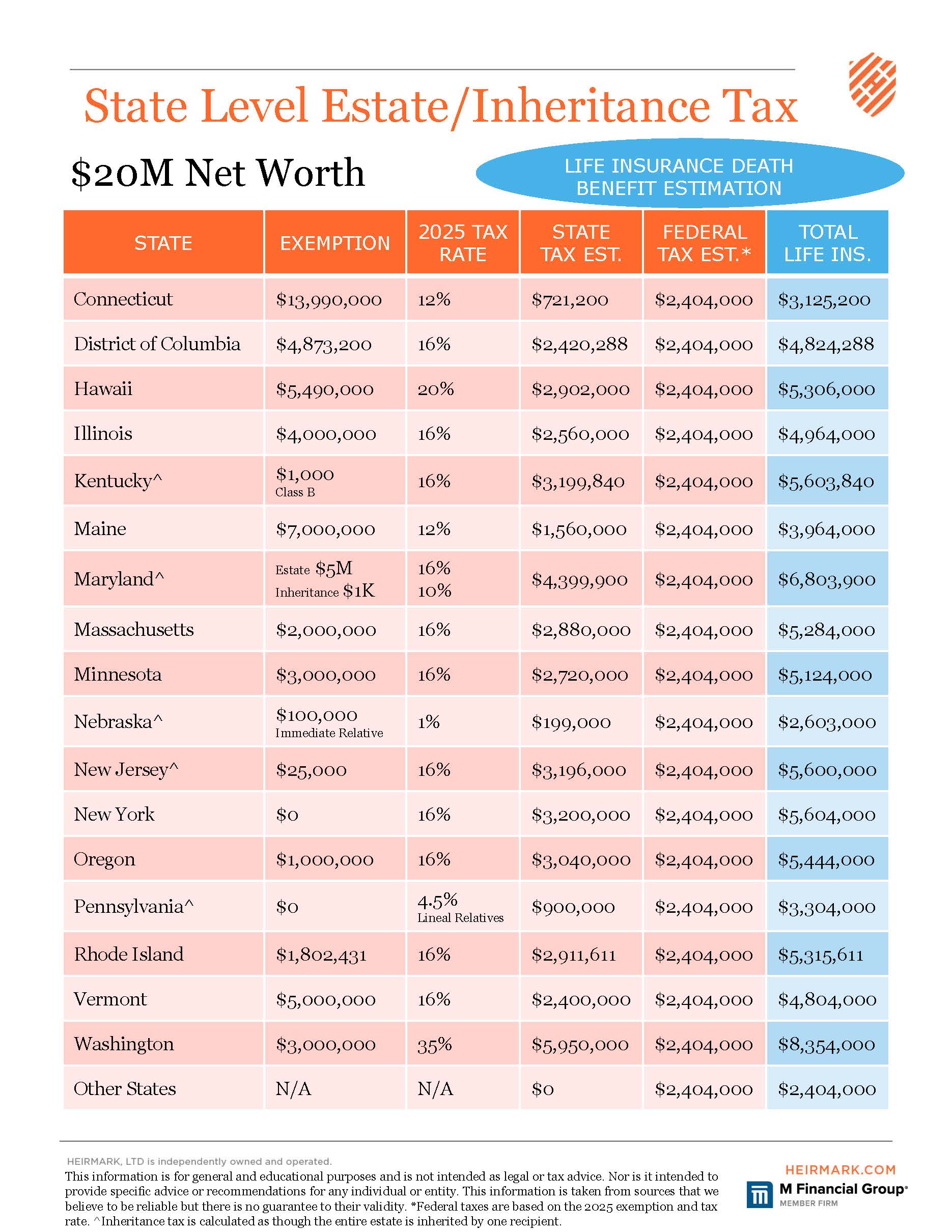
The chart below outlines state and federal tax estimates on a $20 million estate in 2025 with tax estimates and life insurance death benefit amounts that cover both the state and federal taxes. When assessing state level taxes, consider in which state each trust is established, where vacation properties are located, and where companies, corporations, and LLC’s are domiciled. These details will drive the governing tax laws for each estate. The amount of tax that will be due continues to flux for exemption limits that are indexed for inflation, so a routine review of an estate plan is a prudent exercise. As with federal estate taxes, any state level taxes can be offset using life insurance death benefit, alleviating the tax burden on heirs.
Contact us with any questions or opportunities to help you or your clients achieve identified goals. This is what we enjoy doing for only a select number of families, businesses, and charitable institutions each year, and we look forward to hearing from you.