By Raymond Nash
Using Life Insurance for ROI
Case Study – Building a Family Legacy
Smart investors know that a diversified portfolio can be the key to a successful investment strategy. Using life insurance policies for their return on investment (ROI) potential can be advantageous.
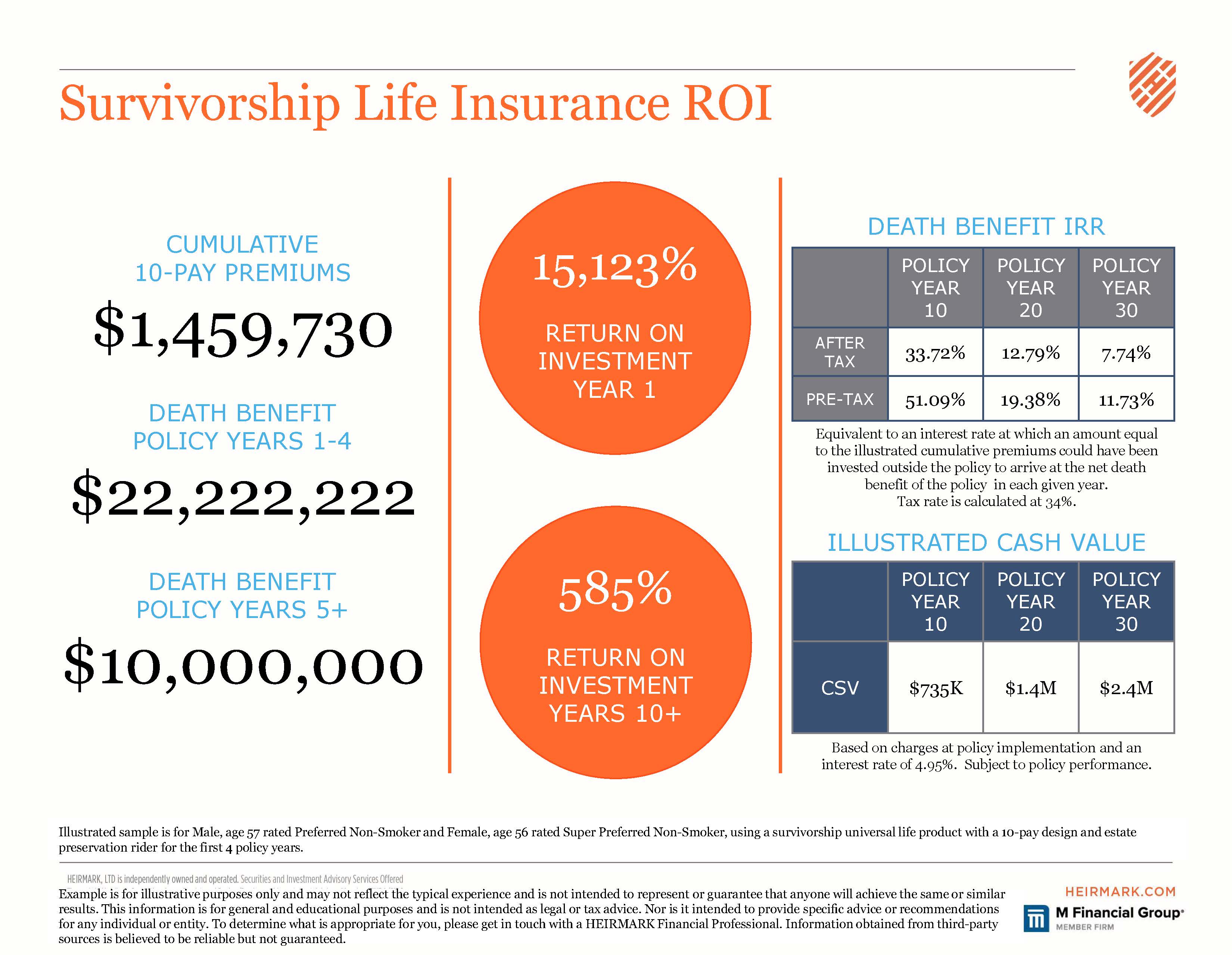
We recently guided our Valued Clients in implementing a policy to help build on their family’s legacy. They were interested in placing a $10M survivorship life insurance policy to not only offset any applicable estate taxes but to preserve their wealth for future generations. By using a short pay design, they were able to leverage an illustrated cumulative premium of $1,459,730 (paid over 10 years) into $10,000,000 of death benefit. Additionally, the lead insurance carrier offers an Estate Preservation Rider, increasing their death benefit to $22,222,222 for the first 4 policy years. As you can see in the graphic below, the ROI in policy year one was 15,123% and the ROI after all the scheduled premiums are paid in policy year 10 is projected to be 585%.
Of course, ROI does not account for any risk associated with this strategy. When using a universal life chassis, the illustrated premiums are dependent on the charges inside the policy and the crediting rate, which are not guaranteed. These parameters are set by the insurance carrier. We pride ourselves on working with quality insurance carriers that have a proven track record and a history of meeting their financial obligations. Investing premiums into a life insurance death benefit is not as dependent on the market as other investments might be, since actuarial calculations and underwriting ratings hedge the risk for each insurance carrier. Additionally, the death benefit is income and estate tax-free when the policy owner is properly structured.
To further evaluate risk and the time value of the investment, we can look at the Internal Rate of Return (IRR). The death benefit IRR is equivalent to an interest rate at which an amount equal to the illustrated premiums could have been invested outside the policy to arrive at the net death benefit of the policy. IRR’s are generally calculated as an after-tax return on the investment. In the graphic below, we have included the pre-tax IRR as well, using a tax rate of 34%. Based on the illustration, the same premium of $145,973 per year would need to earn an after-tax return of over 33% consistently each year for 10 years to gross the equivalent of the $10M death benefit in policy year 10. Even in policy year 30, the after-tax IRR is illustrated at 7.74%, which is above the historical average ROI for the S&P 500 (widely considered to be about 7.00%) making this strategy worth consideration.
Contact us with any questions or opportunities to help you or your clients achieve identified goals. This is what we enjoy doing for only a select number of families, businesses, and charitable institutions each year, and we look forward to hearing from you.