By Raymond Nash
Using Life Insurance for ROI
Case Study – Retirement Income
Smart investors know that a diversified portfolio can be the key to a successful investment strategy. Using life insurance policies for their return on investment (ROI) potential can be advantageous.
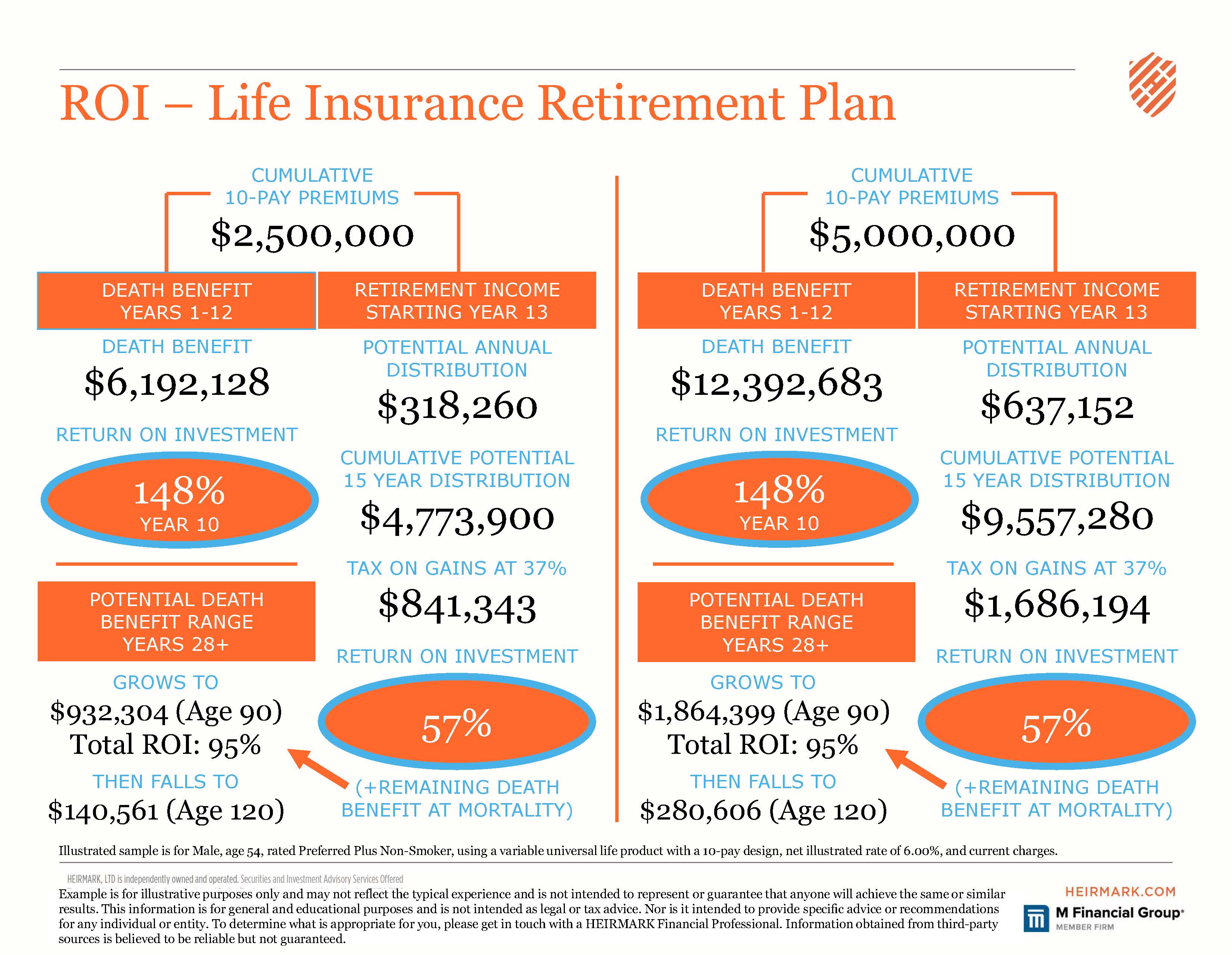
Our valued client is selling one of his companies and wants to leverage the ROI inside a life insurance policy for future retirement income. We illustrated two funding options for him, both 10-pay designs, at $250K and $500K annual premiums. As with any life insurance policy, the ROI in early policy years is the strongest when considering premiums paid versus the death benefit. In policy year one, the ROI after the first premium payment is 2,376%. As the premiums are paid, the ROI decreases each year, landing at 148% in policy year 10, after all illustrated premiums are paid but before the distributions for retirement income begin.
Based on the client’s planning, we are illustrating retirement income to start in policy year 13 (his age 66). Retirement income is received via distributions from the policy by way of policy loans. A loan is taken from the policy’s cash value each distribution year, letting the loan interest accrue inside the policy until our valued client’s mortality. The policy loans and loan interest decrease the cash value and death benefit of the policy accordingly. In the example below, we have illustrated 15 years of distributions from the policy. Assuming a net non-guaranteed rate of 6.00% and current policy charges, there is an illustrated death benefit available each policy year, before, during, and after the distribution phase of the policy. However, the planned distributions and accrued loan interest cause the illustrated death benefit to fluctuate each year. It’s also important to note that while the death benefit can be income tax-free and cash value grows income tax-free inside the policy to fund the retirement income, the distributions will be taxed as regular income once they exceed the basis amount (premiums paid into the policy).
The ultimate goal is for our valued client to use the living benefit of retirement income during his lifetime and then his heirs will receive the death benefit at his mortality. For example, if our valued client has a mortality at age 90, he is illustrated to have already received all 15 years of distributions PLUS the remaining death benefit will be paid to the policy beneficiary. When considering the total amount of distributions plus the illustrated death benefit, the total ROI for a mortality at valued client’s age 90 is illustrated to be 95%.
Contact us with any questions or opportunities to help you or your clients achieve identified goals. This is what we enjoy doing for only a select number of families, businesses, and charitable institutions each year, and we look forward to hearing from you.