By Raymond Nash
Learning from Celebrity Experiences
Kyle & Samantha Busch
Celebrities facing financial planning challenges often find their stories making headlines. These experiences serve as valuable learning opportunities, highlighting pitfalls to avoid when assembling a financial portfolio. The attention these cases receive sparks public discussion and may influence future approaches to constructing a lucrative financial plan.
In November of 2025, Kyle and Samantha Busch filed a lawsuit against their insurance carrier and agent, claiming misrepresentation and mishandling of their life insurance policies, leading to a reported loss of $8,582,007 across multiple policies. This case underscores the critical importance of working with a trustworthy and skilled insurance agent when establishing a life insurance portfolio. It is essential to engage an agent who prioritizes not only the placement of coverage but also the ongoing service responsibilities throughout the policy's duration.
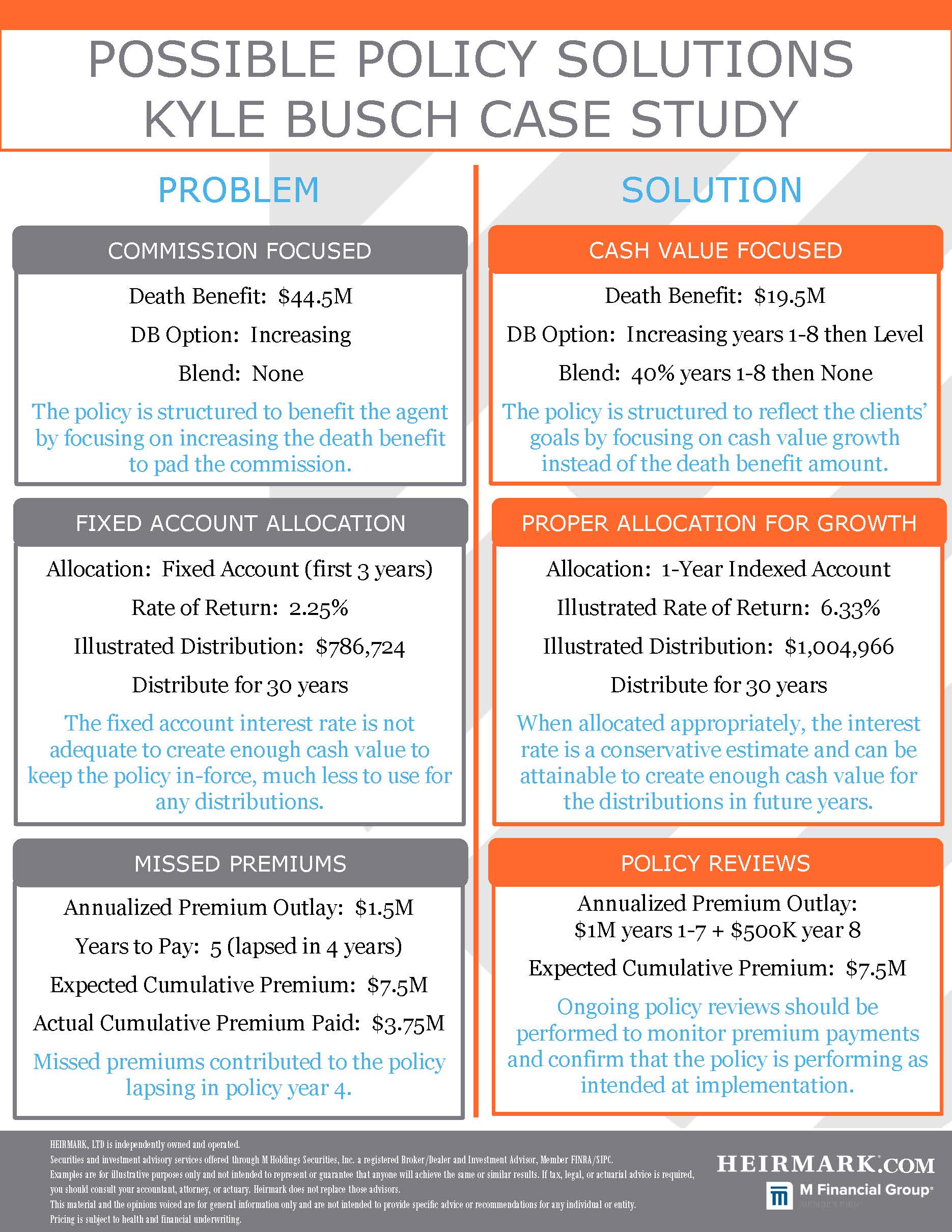
While the exact details are unknown, some articles highlight key aspects of the policies involved. Notably, a $44.5 million indexed universal life (IUL) policy was issued in 2020 on Kyle’s life. It appears that this policy was initially intended as a retirement vehicle. Life Insurance Retirement Plans (LIRPs) can be a good option to supplement other retirement planning, but this policy had a number of missteps. Outlined in the graphic below are some of the most prominent problems that resulted in a lapsed policy instead of retirement income, along with an outline of a functional policy solution that could have been written for the same premium cost and a higher income stream.
The first alleged misstep occurred during the implementation phase. It appears the insurance agent may have prioritized a substantial commission over the client's best interests. Given the intent to enhance cash value for future disbursements, the policy should have been illustrated to maintain a lower death benefit. Instead, it seems the death benefit was inflated by utilizing all commissionable base coverage rather than a blend of base coverage and non-commissionable annual renewable term coverage. In the example below, there is about a million-dollar decrease in the commission just from structuring the policy’s death benefit appropriately.
The second alleged misstep regarding the $44.5 million IUL policy should have been addressed during its implementation phase or service phase. The performance of an IUL policy relies heavily on how premium dollars are allocated. In this case, it has been reported that the funds were allocated to the fixed account for the first three policy years. While the exact expected rate of return for this policy is not reported, a conservative estimate for an IUL policy is around 5.00%-6.00%. The fixed account offers a return of only 2.25%, which falls short of the interest needed to sustain any retirement income goals. This allocation appears irresponsible, especially given the availability of more competitive indexed options.
The third alleged misstep should have been identified during the policy service phase. It’s reported that the policy was illustrated as a 5-pay premium design, indicating that premiums are paid for the first five years, after which no further payments should be necessary if the policy meets its intended interest rate each year. However, the policy was set up with a semi-annual premium structure, splitting the annualized premium of $1.5 million into two payments of $750,000. Confusion seems to have arisen regarding the premium payments, resulting in annual premiums of $750,000 being made instead of the full amount of $1.5 million each year (along with one additional semi-annual payment of $750,000). Over four policy years, $6 million should have been contributed, but only $3.75 million was actually paid.
It appears that in 2024, the policy charges exceeded the cash value, leading to a lapsed policy. This situation suggests a failure on the part of the agent to prioritize the client's best interests. Policies should be tailored to align with the client's goals. In this instance, increasing the death benefit for commission gains was unscrupulous, the allocation to the fixed account was inappropriate, and the missed premiums should have been rectified. A better policy could have been written if the agent had considered their clients’ goals over their own. A straightforward annual policy service review, an essential responsibility for any diligent insurance agent, could have identified both a misallocation of funds and missed premiums. While the other policies in the Busches' portfolio have not undergone extensive public review, it is reasonable to assume that similar missteps may have occurred.
Altogether, the Busches have brought to light a very poor example of proper insurance industry practices. This does not reflect the concierge level of service that we know our clients deserve. While nobody is perfect, we purposefully go the extra mile for our clients, endeavoring to help them create an insurance portfolio that works for them. We welcome any questions or opportunities to assist you or your clients in achieving identified goals. We take pride in serving a select number of families, businesses, and charitable institutions each year, and we look forward to hearing from you.