By Raymond Nash
Life Insurance Awareness Month
Planning Now Vs. Later
September is Life Insurance Awareness Month (LIAM). As with most financial vehicles, life insurance takes planning and strategy. Life insurance has an added layer to navigate, since the rate of return is directly correlated with the health of the client. Partnering with a life insurance agent who is knowledgeable about the options available to each client, based on their unique needs and planning goals, is a great way to optimize a life insurance portfolio.
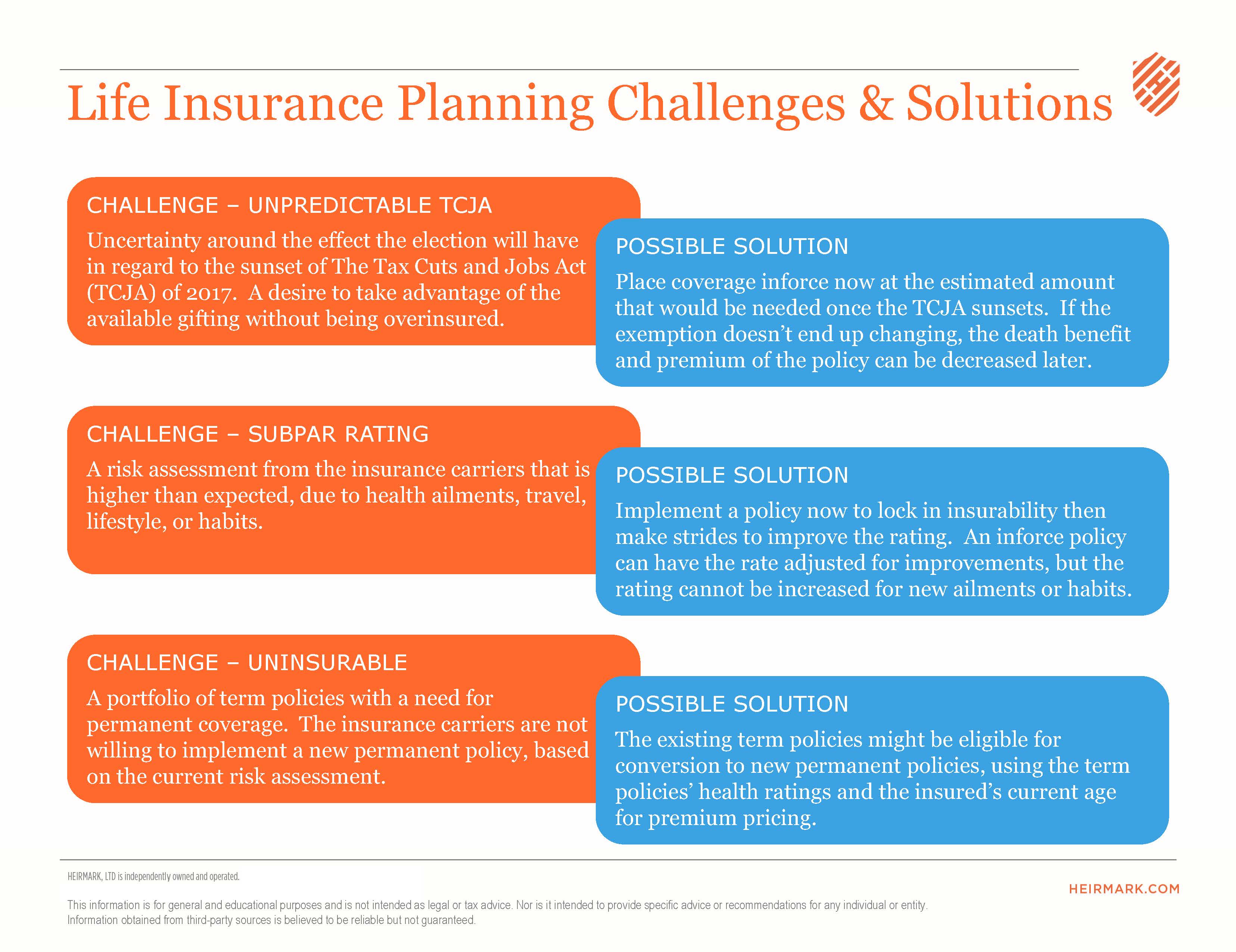
In the graphic below, we have outlined some common challenges and solutions that we have encountered in recent years. Implementing a policy now with the intent to make changes later can be a strategic way to lock in what’s needed at what might end up being the lowest cost available (when compared to future years). Legislation around the estate tax exemption can be unpredictable, but in the long run, individuals can benefit by implementing life insurance to cover estate taxes. Implementing a policy now is a good way to take advantage of the lowest possible age of the client and the gifting advantages available through the end of 2025. The death benefit can always be decreased later, if the full death benefit is deemed excessive.
Additionally, locking in the health of a client now can be advantageous. The future is not guaranteed. We have seen clients who think their health can only improve then suffer an ailment that makes them uninsurable. Implementing a life insurance policy, even if it’s not at an optimal rate, can hedge against any unexpected maladies in the future. A policy’s rate can be revisited if the insured’s health improves, and the rate can be reduced. The benefit of having a policy already inforce is that any newly diagnosed, negative health changes will not affect the rate of the policy after it has been implemented.
While we stress the importance of implementing permanent coverage for permanent needs, uncertainty about the future might make a term policy more appealing for the short-term. The intent of writing a term policy in this instance would be to convert to a permanent product within the conversion window, using the term policy’s health rating and the insured’s current age for premium pricing. In this scenario, the term policy would “lock in” the client’s current insurability to use later, in the event that the insured’s health deteriorates. If the client is able to improve their health in the conversion window, the policy can still be converted with a rating improvement or a whole new policy can be acquired.
Lastly, we have access to several programs at the insurance carriers that can help with life insurance planning. To hedge against the TCJA sunset, one carrier is offering eligible clients who implement survivorship policies from now until December 31, 2024 the option to buy an additional policy in between January 1, 2026 through June 30, 2026 at the same underwriting class, without proof of insurability. Another carrier has a program that allows well-qualified individuals to write a new permanent policy based off the underwriting from a term policy written in the past 3 years. There is another program at an insurance carrier that incentivizes individuals to quit smoking by implementing a policy for a smoker at non-smoker pricing, subject to the individual quitting their habit within a certain number of years after placing the policy. Of course, restrictions do apply to these programs, and we would be happy to navigate these options with you.
Since we spend much of our time working with advisors, many of our new client relationships come directly from attorneys, accountants and wealth managers. We have gained the trust of these advisors, and in turn have earned the privilege to be of service to their clients. Contact us with any questions or opportunities to help you or your clients achieve identified goals. This is what we enjoy doing for only a select number of families, businesses, and charitable institutions each year, and we look forward to hearing from you.