By Raymond Nash
Life Insurance Awareness Month
Risks of Waiting
September is Life Insurance Awareness Month (LIAM). According to LIMRA’s most recent Life Insurance Fact Sheet, the need-gap for life insurance has grown in 2024. This year, a record-high number of adults in America (42%, or 102 million) report that they need life insurance or know that they are underinsured. We at Heirmark have witnessed the tragedy that underinsured families and businesses can endure, believe wholeheartedly in the advantages that life insurance can provide, and strategize with our affluent clients’ advisory teams to help find solutions to fit each financial portfolio.
We know that implementing life insurance can be a tedious endeavor. But we stress the importance of implementing coverage as soon as a client is able and addressing each step of the process as quickly as possible. Since the pricing of the products is based on a risk assessment that covers health, habits, avocations, age, etc., any drastic changes will alter the power of the investment. We have witnessed several clients who waited to address their insurance needs, and their premiums increased during their wait.
Usually, the biggest factor for a premium increase is an individual’s health. We have seen healthy individuals diagnosed with cancer, autoimmune issues, and heart conditions during the underwriting process. Best-case scenario, these diagnoses altered the offers that were available to them, causing an increase in the cost of the insurance that was needed. Worst-case scenario, the individual no longer qualified for coverage at all. It can be devastating to watch clients put off this endeavor to their own detriment.
Another factor that alters a client’s premium is their lifestyle. Clients who have risky habits think they can adjust their living to reap the benefits of lower premiums in the future. A good example is an individual who smokes. The premium can just about double for a smoker versus a non-smoker, so a smoker thinks they can just quit smoking to lower their premium cost. However, the damage that is done by smoking is not reversed upon smoking cessation and can lead to other diagnoses that are more cost prohibitive. There are creative ways to navigate a policy for someone who wants to quit smoking. We partner with an insurance carrier who has a quit smoking incentive that can decrease the premium cost (if the individual otherwise qualifies). Additionally, any policy that is placed inforce with a smoker rating can be re-visited if the client is able to quit smoking, with a possible result in rate reduction and a lower premium (if all other health history remains the same). This strategy can only result in a lower premium, since the rating of an inforce policy cannot be increased after implementation, no matter what new ailments are diagnosed.
Age is another big factor for life insurance pricing. While it’s obvious that a 40 year old client will pay less in premium than a 60 year old client, it’s less clear that a 54 year old client will pay much less than a 55 year old client. There are age thresholds that life insurance products increase the premium at. Additionally, a person’s age changes at their half birthday for most insurance carriers. It’s called age nearest pricing. We have the ability to backdate a policy to save age for the client in a limited window, but that strategy can have a cost attached to it. We try to help clients implement coverage before their half birthday to avoid these additional costs.
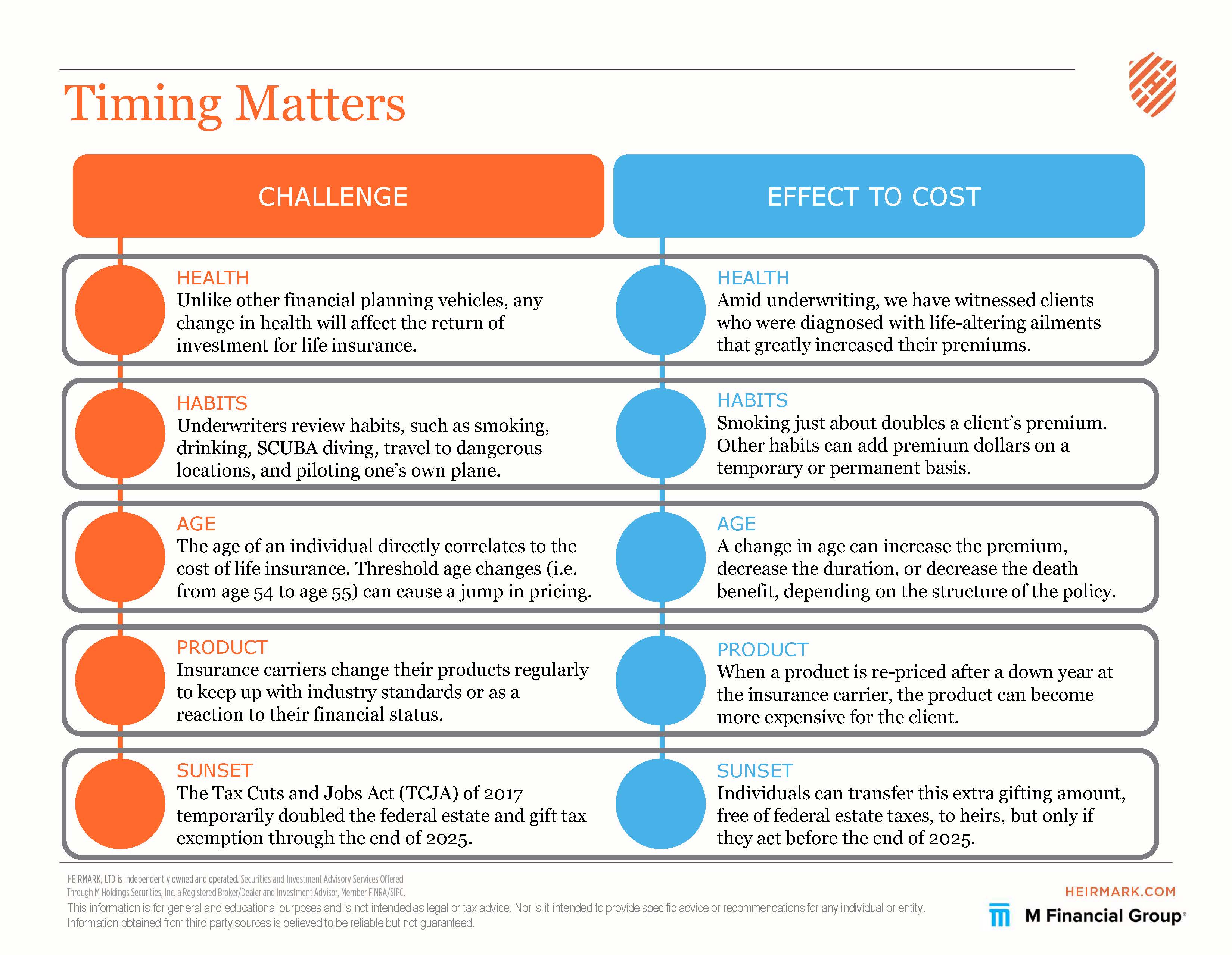
There are a couple of other considerations when determining the appropriate timing for implementing a life insurance policy, as outlined in the graphic below. Our goal is to navigate these challenges to help our clients implement the most cost-effective policy available to them, whatever the circumstances.
Since we spend much of our time working with advisors, many of our new client relationships come directly from attorneys, accountants and wealth managers. We have gained the trust of these advisors, and in turn have earned the privilege to be of service to their clients. Contact us with any questions or opportunities to help you or your clients achieve identified goals. This is what we enjoy doing for only a select number of families, businesses, and charitable institutions each year, and we look forward to hearing from you.