By Raymond Nash
Life Insurance Taxation Nuances
Tax Advantaged Strategy
We all know Benjamin Franklin’s famous words, “In this world nothing can be said to be certain, except death and taxes.” While this statement remains true, tax laws continue to flux, evolving the amount of income, capital gains, estate, state-level, property, etc. taxes that are due each year. While the 2025 tax law did not have a drastic effect on the insurance industry as a whole, there are some tax-related nuances to consider when adding insurance products to a financial portfolio or when auditing existing policies.
If a life insurance policy is structured properly, the death benefit can be tax-free, and the cash value inside the policy grows on a tax deferred basis. Additionally, injecting a life insurance policy with premiums, via gifts to a trust, removes the assets from the client’s taxable estate, lowering the tax bill for the client in exchange for a large inheritance left to heirs as part of the overall estate plan. When faced with the uncertainty of how future administrations might change tax law, life insurance built on a universal life chassis can offer flexibility with both living (via cash value) tax-advantaged benefits to the policy owner and after mortality (via the death benefit) tax-free benefits to heirs.
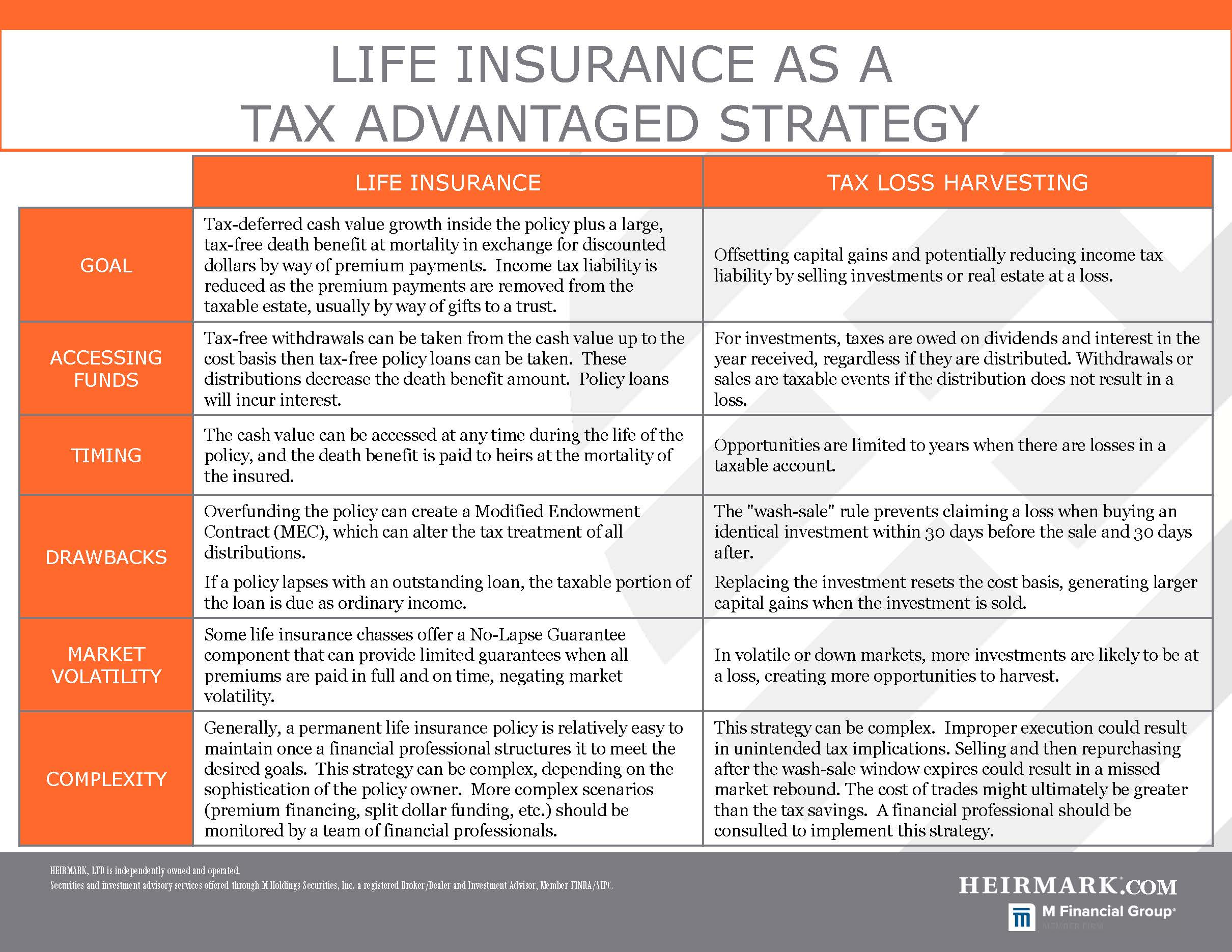
Compared to other strategies, such as tax loss harvesting, life insurance can have some tax advantages as outlined in the graphic below. Adding life insurance can be beneficial when diversifying a financial portfolio, especially when considering long-term planning.
Contact us with any questions or opportunities to help you or your clients achieve identified goals. This is what we enjoy doing for only a select number of families, businesses, and charitable institutions each year, and we look forward to hearing from you.