By Raymond Nash
Tax-Advantages
Life Settlements
When taxes are due in April each year, it’s a good time to consider the tax advantages of life insurance. It is widely known that cash value inside a life insurance policy grows tax-free, and the death benefit of a life insurance policy can be tax-free to the beneficiary. However, life insurance products offer more nuanced tax advantages that can be beneficial.
There are several options to consider when it is determined that exiting a life insurance policy is in a client’s best interest. Repurposing the policy for a living benefit might fit the client’s needs. Exchanging the policy for a new policy without premiums might benefit the client’s estate planning. However, if it is determined that there is no use for the life insurance policy as a living or death benefit, a life settlement should be considered before the policy is surrendered, not only for the increased value but for the potential tax advantage.
If the insured is age 70+ and in poor health, a policy owner may have the potential to sell a life insurance policy via a life settlement to a third-party investor in exchange for the death benefit. A life settlement is a strategy that allows a third-party investor to purchase a life insurance policy from the policy owner for an amount that is higher than the surrender cash value but lower than the death benefit. Life settlements can be attractive for individuals who no longer need the death benefit but would like to receive a larger return on the premiums that have been invested into a policy than the surrender cash value would yield.
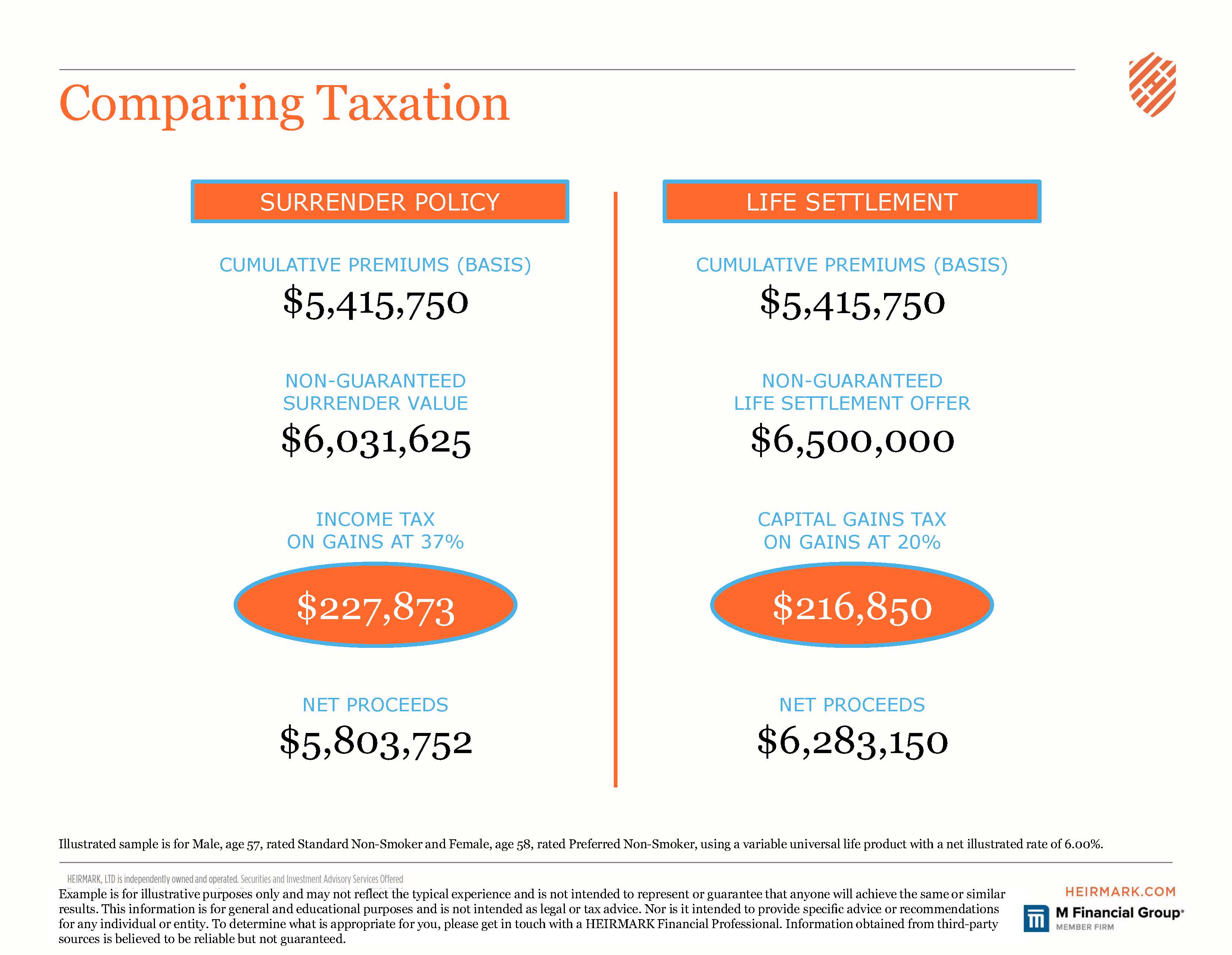
If a policy is surrendered, the surrender cash value is paid to the policy owner and taxed accordingly. If the policy owner is an individual, their income tax rate applies to any amount over basis, which can be as high as 37% in 2025 for total income over $609,350. If the policy owner is a trust, the trust income tax rate applies to any amount over basis, which can be as high as 37% in 2025 for total income over $15,200.
A life settlement uses the capital gains tax rate, which is limited to 20% for any amount over basis (the amount of premium paid into the policy), as long as the policy was implemented for at least one year before it was sold. As new legislation is passed, these rates might change. It’s important to contemplate the most tax-efficient path for each client when considering their life insurance exit strategy.
Contact us with any questions or opportunities to help you or your clients achieve identified goals. This is what we enjoy doing for only a select number of families, businesses, and charitable institutions each year, and we look forward to hearing from you.