By Raymond Nash
Business Planning Using Life Insurance
Term Coverage Vs. Permanent Coverage
There are several ways that life insurance can enhance financial planning for your or your clients’ businesses. From buy/sell funding to executive benefits, using discounted dollars by way of premium payments to fund certain expenses with a death benefit makes a lot of sense for many business owners. Additionally, the cash value inside a permanent policy can be accessed to use as a living benefit. Every business should consider life insurance solutions as part of their financial planning.
There are two main categories of life insurance: term and permanent. Term coverage has its benefits for temporary needs when insuring young, healthy individuals who do not have any additional risk factors. Permanent coverage is more beneficial for long-term needs and when insuring older, less healthy individuals who have unhealthy habits or take part in risky avocations (SCUBA diving, racing, sky diving, etc.).
Most term insurance is structured as “Level Premium Term” for a specified period such as 10-years, 15-years, or 20-years. If the need for life insurance exceeds the duration of the term period, then the policy owner might be able to convert to a permanent policy. Restrictions apply to the timeline and available products, and the converted policy will be priced according to the insured’s attained age. If the goal is to place another term policy after the initial term policy expires, then the insured will have to re-qualify for a new policy through new underwriting. The pricing for the new policy will be based on the insured’s current age, health status, habits, and avocations.
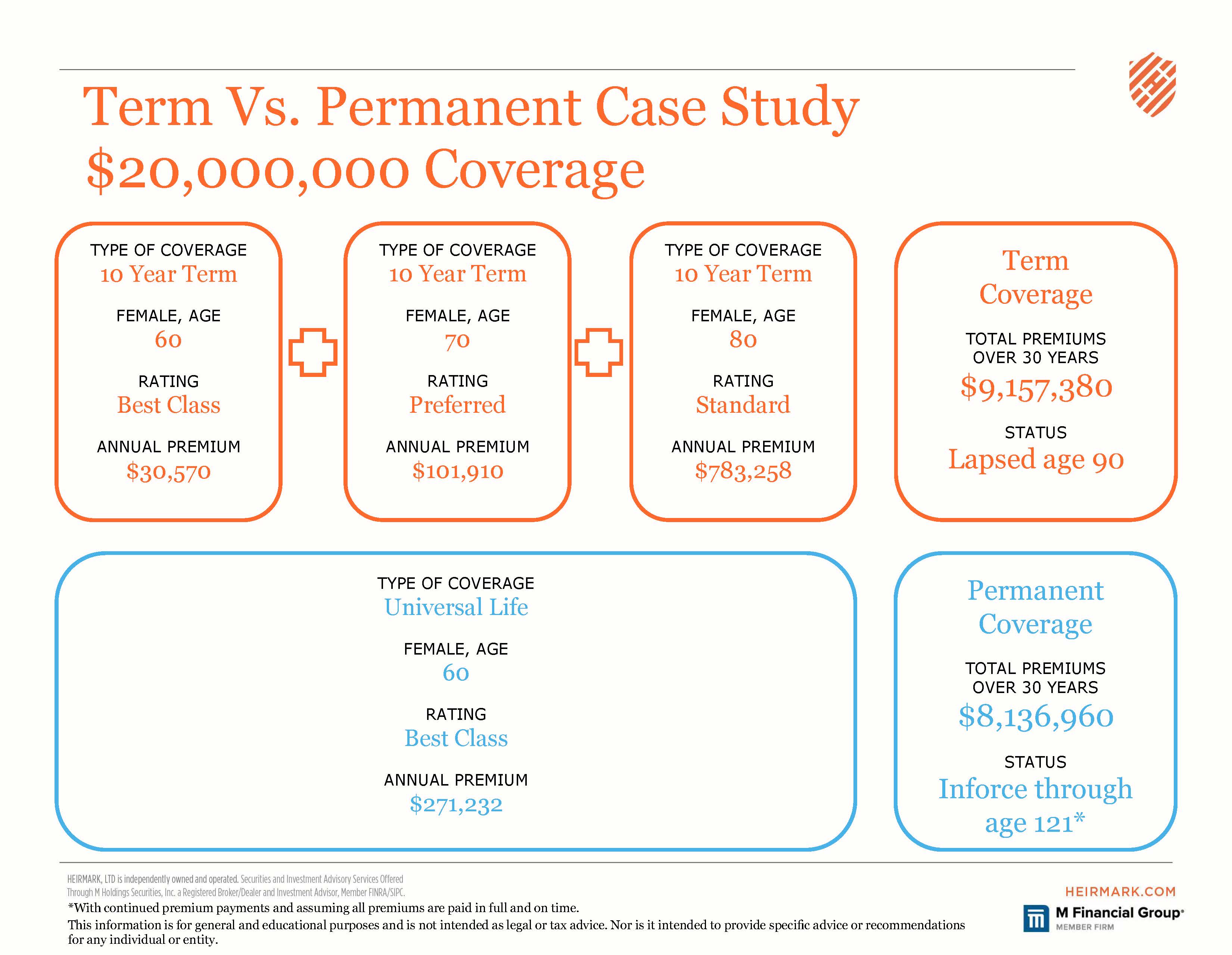
Qualifying for a new policy after the initial term period can be challenging, because a lot can change for a person over 10, 15, or 20 years. In the example below, our sample client qualified for best class at age 60 but her health worsened as the years progressed, leading to more and more expensive term premiums. At the end of a 30-year period, the permanent coverage would have been less expensive to implement from the start. When writing permanent coverage, the rating is locked in at policy implementation and the insured’s health does not affect the cost in future policy years, as long as the policy remains inforce as illustrated. Additionally, some insurance carriers offer credits for their risk assessments for permanent coverage, making the offer for a permanent product more appealing than the offer for a term product.
Term insurance can be cost-effective if there is certainty that the duration of coverage needed is limited to a specific period of time and the insured is very healthy. If the need for coverage is anticipated to exceed a certain time frame, if the insured is over age 55, or if the insured has unhealthy habits or participates in risky avocations, permanent life insurance should be considered.
Contact us with any questions or opportunities to help you or your clients achieve identified goals. This is what we enjoy doing for only a select number of families, businesses, and charitable institutions each year, and we look forward to hearing from you.