By Raymond Nash
Women’s History Month
The History of Unequal Access to Life Insurance
During the month of March, we are taking time to celebrate #WomensHistoryMonth. Historically, women have been presented with fewer opportunities due to their financial status. Prior to 1839, it was illegal for women to sign legal contracts, including life insurance applications. At marriage, a woman became the property of her husband, and he became the owner of all her property as well. Many men implemented life insurance, but if a man was indebted at death, any available death benefit would pay his debtors before his widow would receive anything.
In 1839, states began passing the Married Women’s Property Act, allowing life insurance proceeds to be passed to a widow instead of being paid to her deceased husband’s debtors. In the mid- to late- 1800’s, more laws were passed that determined joint ownership between a husband and wife. Women started to sign legal documents and implement life insurance policies. With women seeing the benefit of life insurance, the total death benefit of policies jumped from $4 million in 1839 to $600 million in 1865.
One of the first women to own an insurance policy was women's rights activist, Susan B. Anthony. In the 1880s, women began to petition The University of Rochester to allow them to enroll. In 1900, the university's board of trustees challenged women to raise $110,000 to be allowed entry. When the funding fell short, Susan B. Anthony pledged the cash value of her life insurance policy to bridge the gap and the first female students started classes that autumn. Just one example to demonstrate that life insurance can be a versatile product and used for various purposes.
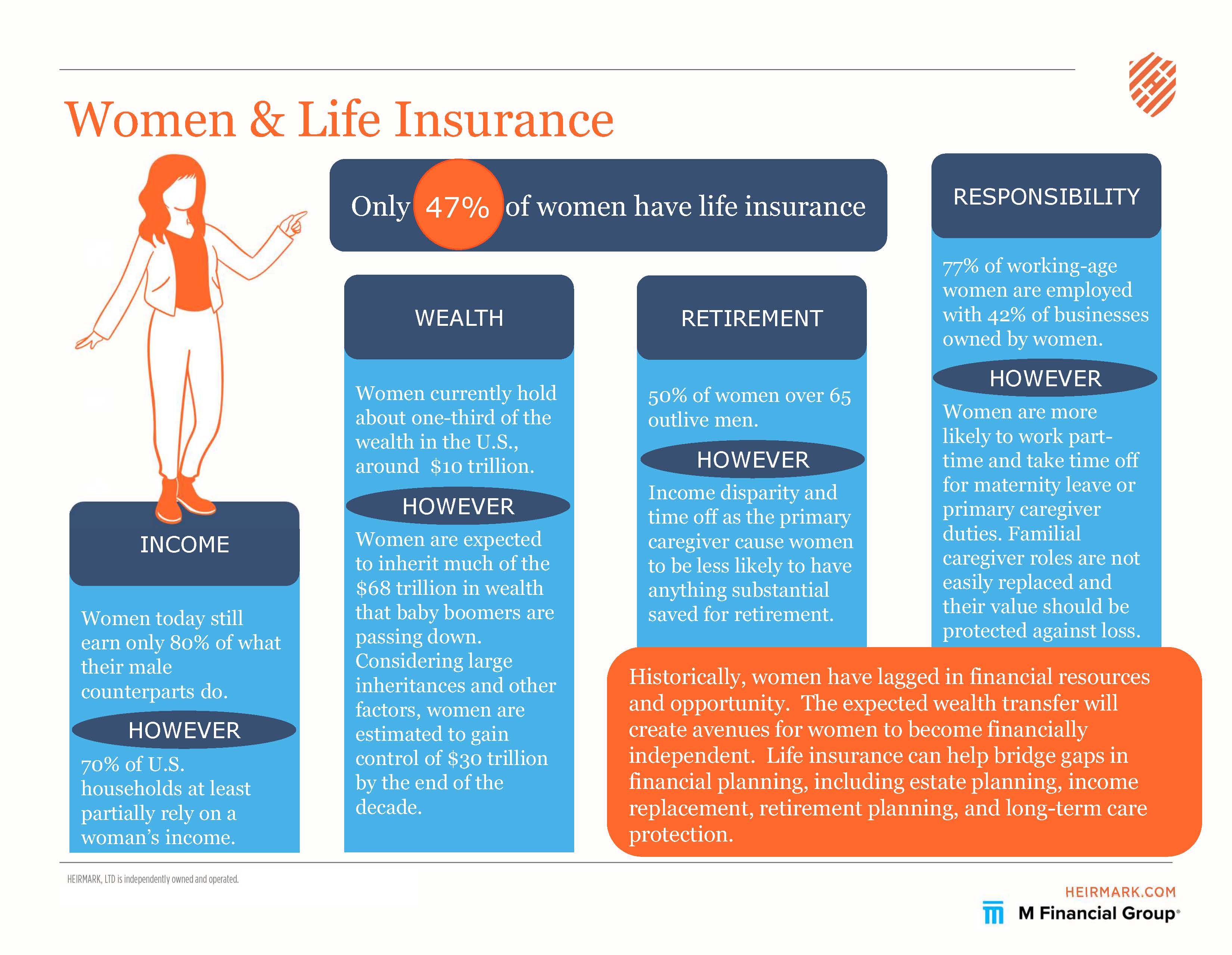
During the Great Depression, life insurance companies experienced gains. In 1940, women purchased over 900,000 life insurance policies, accounting for 20% of all sales. By 1942, women accounted for 30% of total life insurance sales. But those numbers have more recently stagnated. Currently, only 47% of women have life insurance.
Women are poised to control an unprecedented amount of wealth within this decade. The importance of life insurance was not lost on past generations of women and should be considered as a potential component in every financial portfolio. Between companionship, income, and a role as the family’s primary caregiver, reliance on women helps to drive our country. Their loss can create a void that is difficult to fill. And while death benefit is generally the main utilization, there are living benefits that can be accessed within a life insurance policy, too. A candid, informative discussion about how life insurance can benefit an individual is a good first step in developing solutions that might help you or your clients achieve their goals.
Contact us with any questions or opportunities to help. This is what we enjoy doing for only a select number of families, businesses, and charitable institutions each year, and we look forward to hearing from you.